In 2026, the 'Perimeter' is officially dead. Network security now revolves around Zero Trust Architecture (ZTA), where identity is the new firewall.
Key 2026 paradigms include: • Mesh Overlays: Moving away from centralized gateways to peer-to-peer WireGuard meshes. • Encrypted DNS (DoH/DoT): Essential for preventing metadata leakage and man-in-the-middle attacks. • AI-Augmented Monitoring: Using tools that identify behavioral anomalies rather than just static signatures. • Smart Device Compliance: Adherence to the March 2026 mandatory standards for unique passwords and vulnerability reporting.
Related Articles
Passkeys
Mar 03, 2026
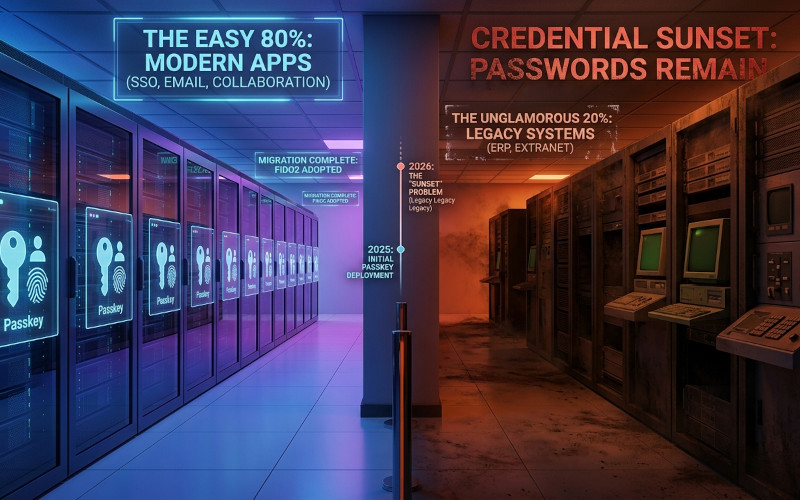
The Credential Sunset: A 2026 Enterprise Playbook for Passwordless Migration
By Michael Rodriguez
Passkeys for the SSO portal are the easy part. The real test of a 2026 passwordless migration is the legacy ERP, the vendor extranet, and the helpdesk call deciding who gets their identity back. Here's the enterprise playbook for closing that gap.
Mobile Security 2026: Securing the Post-Password Device
By Michael Rodriguez
As passkeys replace passwords and mobile APIs handle 80% of global transactions, your smartphone is no longer just a tool—it is your primary identity. Discover the essential shift to Mobile Zero Trust.
Still the industry standard for packet analysis. In 2026, it is primarily used for troubleshooting TLS 1.3/ECH (Encrypted Client Hello) handshakes and analyzing traffic patterns even when the payload is fully encrypted.
The quintessential discovery tool. In modern workflows, Nmap is often integrated into automated CI/CD pipelines to ensure no 'Shadow IoT' or unauthorized services appear during new deployments.
A powerful network security monitor that goes beyond simple packet capture. It converts traffic into high-level events, making it indispensable for AI-driven threat hunting and long-term network forensics.
A hardened, open-source firewall. With its 2026 updates, it features seamless integration with Zenarmor for AI-based web filtering and robust support for Post-Quantum cryptographic VPN tunnels.
The leader in 'Zero Config' mesh VPNs. It uses WireGuard to create a flat, secure network across all devices, utilizing identity providers (SSO) to enforce strict, per-user access policies.
A fully open-source alternative to Tailscale. NetBird combines a mesh VPN with a built-in access control engine, allowing you to define exactly which devices can talk to each other based on tags.
The gold standard for anonymity. In 2026, Mullvad remains a favorite for its 'account-number-only' system and early adoption of quantum-resistant tunnels for all users.
Swiss-based security with a focus on 'Secure Core' architecture. It now includes advanced anti-censorship features and network-level ad/malware blocking that operates before data hits your device.
Network-wide DNS filtering that enforces 'DNS-over-HTTPS' (DoH). These tools block tracking and malware at the source, preventing devices from ever 'phoning home' to malicious domains.
The baseline for modern wireless. Its 'Simultaneous Authentication of Equals' (SAE) makes offline dictionary attacks virtually impossible, even with weak passwords.
Mandatory regulations (starting March 2026) requiring all network-connected smart devices to have unique passwords, transparent update periods, and public vulnerability reporting channels.