
The Credential Sunset: A 2026 Enterprise Playbook for Passwordless Migration
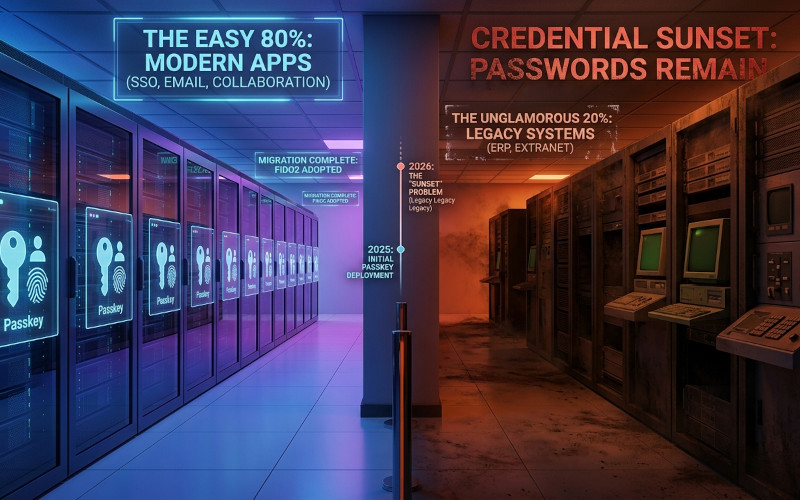
Passkeys for the SSO portal are the easy part. The real test of a 2026 passwordless migration is the legacy ERP, the vendor extranet, and the helpdesk call deciding who gets their identity back. Here's the enterprise playbook for closing that gap.
By early 2026, the headline numbers looked like a victory lap: FIDO2 adoption has crossed 75% across the Fortune 500, and more enterprise logins now happen via Passkeys than passwords. But ask any CISO how the migration is actually going, and the celebration tends to stop. The easy 80%—the SSO portal, the email client, the collaboration suite—is done. What remains is the unglamorous 20%: the legacy ERP, the vendor extranet, and the service account nobody remembers creating. This is the 'Credential Sunset' problem, and it's where most 2026 passwordless projects quietly stall.
The 80/20 Trap: When 'Mostly Passwordless' Isn't Good Enough
The first wave of passkey adoption targets systems built on modern identity standards—anything that speaks OIDC or SAML can usually be retrofitted with WebAuthn relatively quickly. The problem is the long tail: on-prem ERPs from the 2000s, OT/SCADA interfaces, and the dozens of vendor portals that still expect a username and a static password. Leave these untouched, and you haven't eliminated your password attack surface—you've simply relocated it to the systems with the weakest logging and the oldest patch cycles. A 2026-grade migration treats this 'shadow password estate' as a first-class risk, not an afterthought for 'someday.'
The Recovery Paradox: Securing the Keys to the Kingdom
When a passkey lives inside your device's secure enclave, losing that device doesn't just lock you out—it can sever your entire digital identity. This has made account recovery the single highest-value target for attackers in 2026. Helpdesks, once a minor support function, are now a primary social engineering battleground, with AI-voice-cloned 'employees' calling in to request an emergency credential reset. Enterprises that get this right have abandoned SMS and email-based fallback entirely, replacing them with cryptographically-verified 'Trusted Contact' delegation and a recovery ceremony that pairs cryptographically-signed video with a separate, out-of-band confirmation step—because in a world of real-time deepfakes, a video call alone proves nothing, and a high-privilege reset should never hinge on a single channel.
2026 Passwordless Migration Roadmap:
- Tier Your Identity Estate: Before rolling anything out, classify every application—Tier 1 (passkey-ready today), Tier 2 (bridgeable via an enterprise credential vault or PAM layer), and Tier 3 (legacy systems needing network-level isolation and compensating controls until they can be retired). For Tier 2, the vault injects the legacy credential behind the scenes so the employee still experiences a single passkey login—an invisible bridge that matters, because a workforce handed 'just one more password' to remember will quietly write it down and undermine the whole rollout.
- Pilot with Champions, Not Executives: Resist the urge to start with the C-suite. Tech-savvy early adopters who enjoy troubleshooting will build the internal documentation and peer support that make the second and third waves of rollout dramatically smoother.
- Harden the Recovery Path First: Redesign helpdesk identity verification and retire SMS/email fallback before flipping the switch on passwordless login—otherwise you've simply moved your weakest link from the front door to the back office.
- Build a Living Governance Policy: Passwordless isn't a project with an end date; it's an ongoing program. Schedule quarterly reviews of exception lists, Tier 3 systems, and recovery logs so 'temporary' workarounds don't quietly become permanent.
The organizations that succeed at this transition won't remember 2026 as the year they 'went passwordless'—they'll remember it as the year they started governing identity as a living system: continuously tiered, audited, and improved, rather than switched on once and forgotten.